
A worked tree is one that at some stage in its life was managed by people to generate wood, timber or tree fodder for a particular use e.g. charcoal making, for firewood and/or building materials.
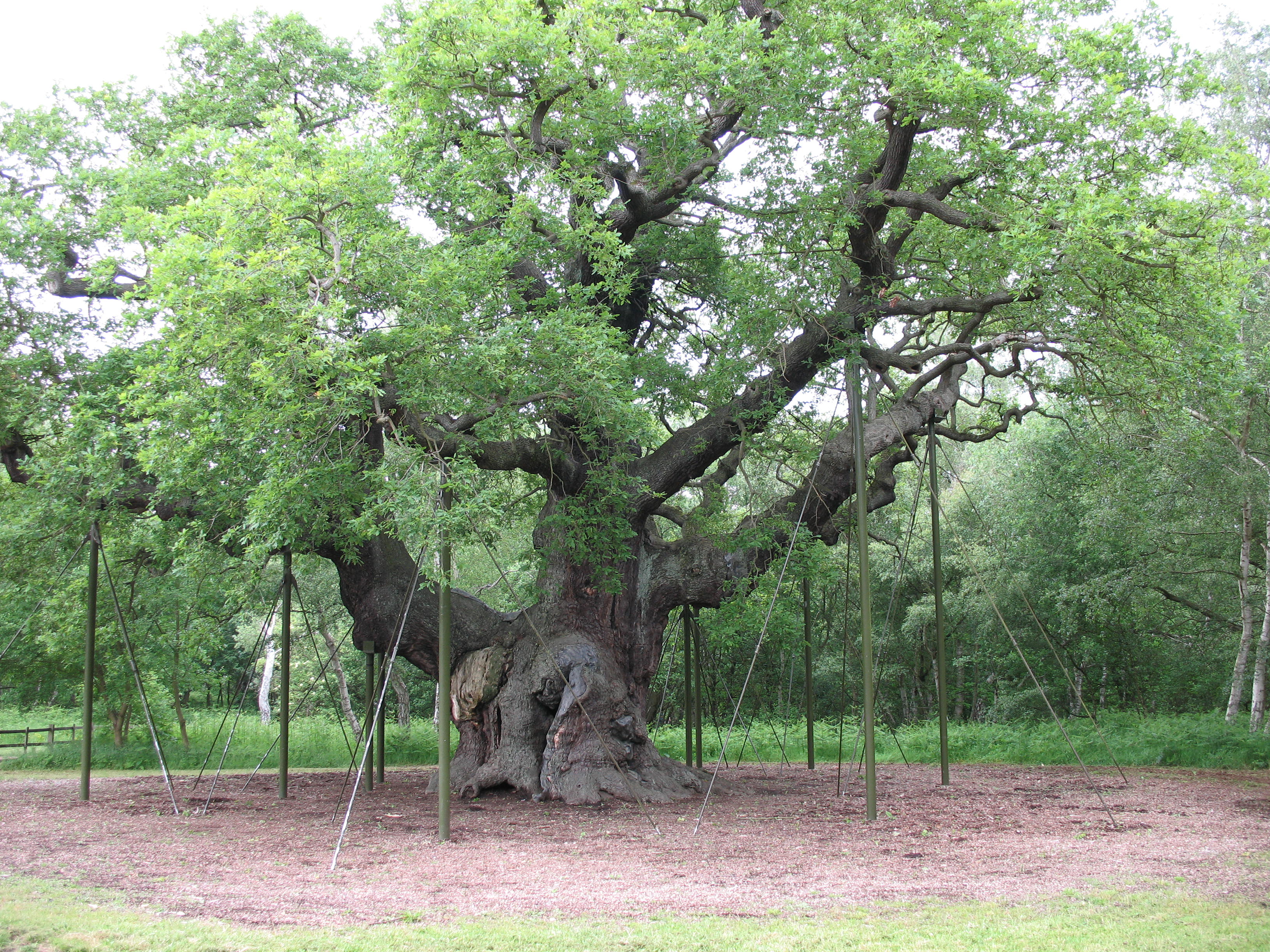
The Major Oak, Sherwood Forest.
These trees are often very old but may look younger because they do not exhibit the classic characteristics of an ancient or veteran tree such as the Major Oak in Sherwood Forest. Worked trees have often been managed for centuries before being abandoned. This abandonment happened on a large-scale locally around the beginning of the twentieth century as the demand for locally sourced wood-based products declined.
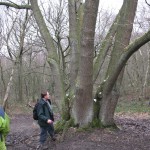
Veteran out-grown coppice
Some abandoned worked trees were felled and removed when woodlands were converted to plantations but there are still many abandoned worked trees which survive today (see photo). They give an insight into the history of an industrial treescape.
The most common form of worked tree found in an industrial woodland is a coppice. This is when the stem of a tree is cut at ground level to encourage growth of multiple stems from the base (known as a stool). These stems (known as poles) are cut back at regular intervals (5 – 30 years) depending on what they are to be used for. It was a very common form of management over several hundreds of years. Many coppice stools and the outgrown stems survive (see photo above). They often now appear as circular clumps of quite large trees with the original base having decayed to form a hollow. Another common form related to coppice management is the stored coppice.
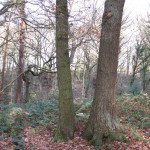
A ‘stored’ coppice stool
The ‘stored’ coppices were created when the coppicing tradition was abandoned. One or two stems were selected from a large coppice stool to continue to grow as standard timber trees. This has sometimes resulted in what is known as an ‘elephant’s foot’ at the base of the tree.
See our survey guide for other examples of types of worked trees. Worked trees can be recorded as part of the living archaeology of an industrial treescape; see the survey section ‘Level 2: Worked Trees’. Related topics include ‘indicator species’; ‘tree species and their uses’; history and archaeology.